There are many features of Dewey's ideas that are quite interesting... First of all, the fact that what he most expected from schools was to form citizens. When I was at school it was usual to see children looking down on other students because they were "different". I remember one of my teachers used to encourage us to listen to each other and respect our differences (e.g. we used to have problems in the classroom regarding the clothes we wore...). I would like to apply this idea of "no discrimation" starting in the classroom, so that my students can apply them in their lives both inside and out of school. I would really like to foster communication among my students to break the differences between them.
However, I believe that Dewey's idea that "the fewer hours children spend at school, the better (just enough to acquire just the minimum concepts)" is quite an exaggeration. I believe that the bases of education are both values and knowledge... so if we leave knowledge out of school... what do we want it for?
Contributed by Alejandra de Antoni
Wednesday, November 15, 2006


Saturday, November 04, 2006
Rousseau on Education
-One of Rousseau's ideas that influences school today is the thought that at the Pre-adolescence stage (12-15) the child should not know about those ideas that are beyond his grasp. Nowadays, when a student makes a question about sth. that is not in the syllabus, many teachers say 'This is a topic for next year,' or 'You cannot understand this now,' and go onto the topic of the day. I don't think this is because the teacher is lazy or not motivated enough to encourage students' curiosity. Perhaps many teachers don't believe in much 'going off track' because they feel the topic is too complex for the students.
-One idea I would like to consider when teaching is that teachers must take into account sex differences (though at all stages, not only at 20-25). With this I don't mean that we should favoured boys or girls, or foster stereotypes. We should pay attention to these differences and encourage students to respect and tolerate each other.
-I also like the idea of 'life as a playground.' I would like to provide an environment in which my students could experience by themselves and make sense of the environment in their own way, not always relying on the teacher. A teacher should cater for children's natural curiosity, thus allowing opportunities for learning.
-One idea I would like to consider when teaching is that teachers must take into account sex differences (though at all stages, not only at 20-25). With this I don't mean that we should favoured boys or girls, or foster stereotypes. We should pay attention to these differences and encourage students to respect and tolerate each other.
-I also like the idea of 'life as a playground.' I would like to provide an environment in which my students could experience by themselves and make sense of the environment in their own way, not always relying on the teacher. A teacher should cater for children's natural curiosity, thus allowing opportunities for learning.
Monday, September 18, 2006
John Dewey
 While analyzing John Dewey's ideas, I was able to find a close relationship with the type of education I had at my secondary school, where the purpose was "Not Multa Sed Multum", which means "not many different things, buteach one in the deep". Moreover, a clear trend nowadays is to find teachersthat devote their classes to favouring the personal experience of the learner and their own creations.
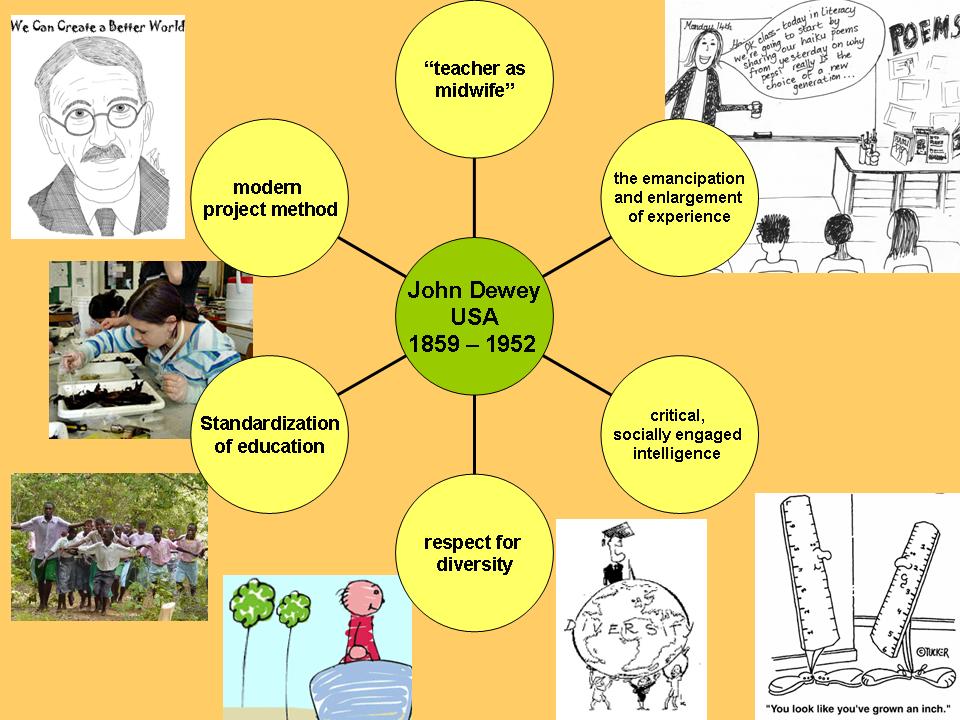
- Nevertheless, at the same time, the teacher's function as a "midwife" (a guide through the process of constructing knowledge) is sometimes replaced by the "explainer", not even thought of by Dewey. I would like to particularly stress Dewey's concern about the development of critical, socially engaged intelligence and respect for diversity.
- As a teacher-to-be, I believe that it is really important to integrate social experience with educational ones, considering Dewey's ideas about socialization, democratization and diversity. It is also important to take into account the idea of emancipating learners and advocating the enlargement of experience, because learners are human beings that are part of a society and they must learn how to manage their experiences.
Subscribe to:
Posts (Atom)

